CO2(g) + Mn2+(aq)
Practice Problem 4
We can determine the concentration of an acidic permanganate ion solution by titrating this solution with a known amount of oxalic acid until the charactistic purple color of the MnO4- ion disappears.
H2C2O4(aq) + MnO4-(aq)
CO2(g) + Mn2+(aq)
Use the half-reaction method to write a balanced equation for this reaction.
Solution
STEP 1: Write a skeleton equation for the reaction.
H2C2O4 + MnO4-  CO2 +
Mn2+
CO2 +
Mn2+
STEP 2: Assign oxidation numbers to atoms on both sides of the equation.
| H2C2O4 | + | MnO4- | |
CO2 | + | Mn2+ |
| +1 +3 -2 | +7 -2 | +4 -2 | +2 |
STEP 3: Determine which atoms are oxidized and which are reduced. The only elements that undergo a change in oxidation state are the carbon atoms in oxalic acid and the manganese atom in the MnO4- ion.
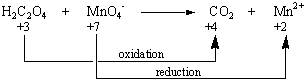
STEP 4: Divide the reaction into oxidation and reduction half-reactions and balance these half-reactions. This reaction can be divided into the following half-reactions.
| Oxidation: | H2C2O4 | |
CO2 | ||
+3 |
+4 |
| Reduction: | MnO4- | |
Mn2+ | ||
| +7 | +2 |
We'll balance the reduction half-reaction first. It takes five electrons to reduce manganese from +7 to +2.
| Reduction: | MnO4- + 5 e- | |
Mn2+ |
Because the reaction is run in acid, we can add H+ ions or H2O molecules to either side of the equation, as needed. There are two hints that tell us which side of the equation gets H+ ions and which side gets H2O molecules. The only way to balance the charge on both sides of this equation is to add eight H+ ions to the left side of the equation.
| Reduction: | MnO4- + 8 H+ + 5 e- | |
Mn2+ |
The only way to balance the number of oxygen atoms is to add four H2O molecules to the right side of the equation.
| Reduction: | MnO4- + 8 H+ + 5 e- | |
Mn2+ + 4 H2O |
We can now turn to the oxidation half-reaction. We might start by assuming that both of the carbon atoms in oxalic acid end up as carbon dioxide. This is therefore a two-electron oxidation half-reaction.
| Oxidation: | H2C2O4 | |
2 CO2 | + | 2 e- | ||
|
+3 | +4 |
We can balance both charge and mass by noting that two H+ ions are given off when oxalic acid is oxidized to carbon dioxide,
| Oxidation: | H2C2O4 | |
2 CO2 + 2 e- + 2 H+ |
as shown in the figure below.

STEP 5: Combine the two half-reactions so that electrons are neither created nor destroyed. Five electrons are consumed in the reduction half-reaction and two electrons are given off in the oxidation half-reaction. We can combine these half-reactions so that electrons are conserved by using the lowest common multiple of 5 and 2.
| 2(MnO4- + 8 H+ + 5 e- Mn2+ + 4 H2O) |
| + 5(H2C2O4 2 CO2 + 2 e- + 2 H+) |
| __________________________________________ |
| 2 MnO4- + 16 H+ + 5 H2C2O4
10 CO2 + 2 Mn2+
+ 8 H2O + 10 H+ |
STEP 6: Balance the remainder of the equation by inspection, if necessary. We can generate the simplest balanced equation for this reaction by subtracting 10 H+ ions from both sides of the equation derived in the previous step.
2 MnO4-(aq) + 5 H2C2O4(aq)
+ 6 H+(aq) 10
CO2(g) + 2 Mn2+(aq) + 8 H2O(l)